



Entre relier et recouper, une géocritique du littéraire
Excerpt from Ana Kiffer’s article published in the journal Fabula – la Recherche en Littérature, originally in French (see PDF below).
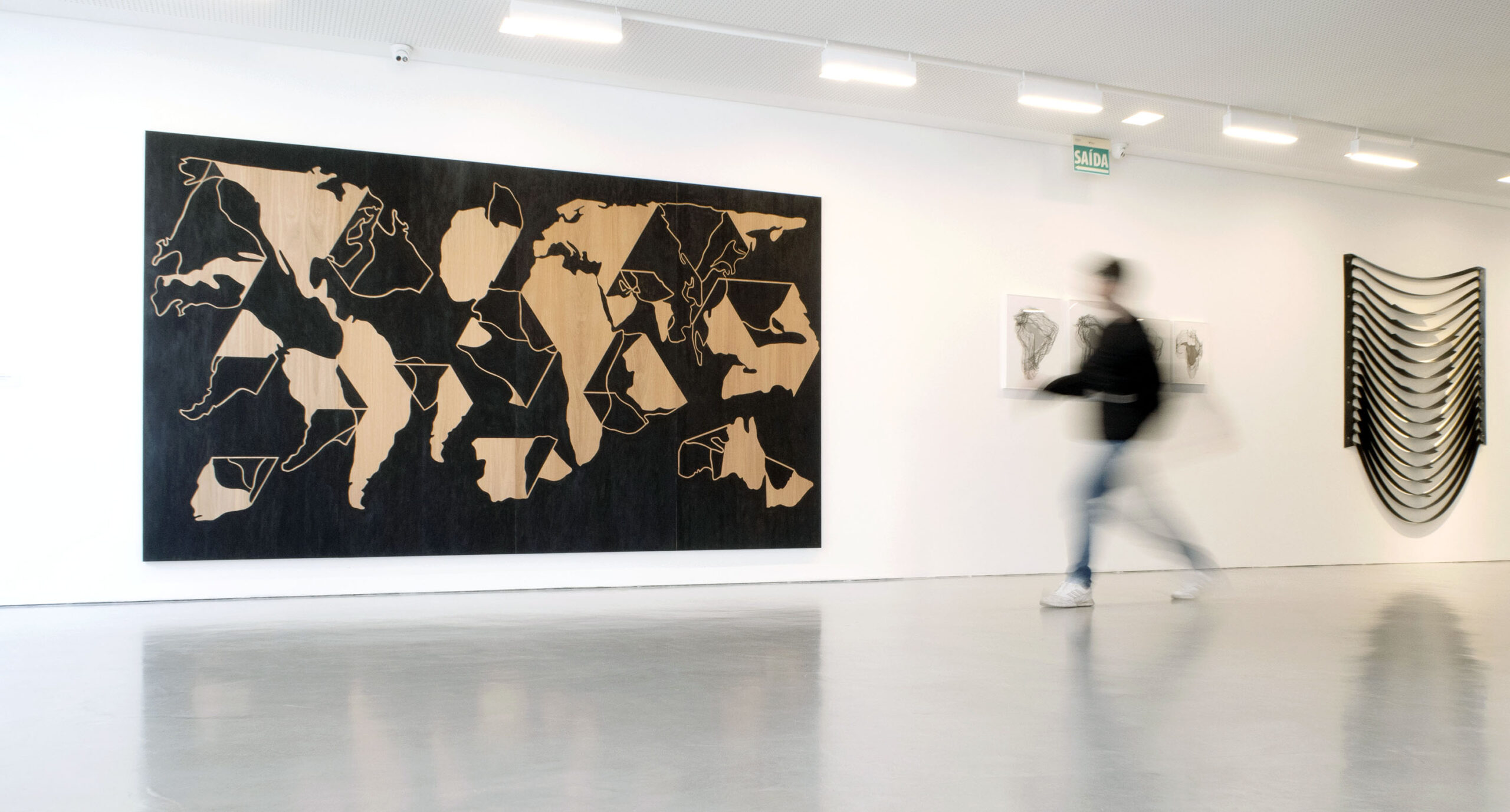
“(…) The first work, from 2023, titled “Unfolded Geographies,” is the one that outlines the hypothesis of this text. This is because it requires two fundamental gestures. One of them is to deconstruct the organization, the contours, and the distributions of the Earth—that is, the imaginary of territory, borders, national identities, and so on. It disrupts—on the perceptual, mental, but also symbolic level—and thus on the affective and imaginary level—our relationship with the representation of the map of the world, of the Earth, or, why not say, of a Whole-World (Glissant, 1997). And this disruption begins with the cut. It is the cut that acts to unfold, in a different way, the outlines of territories—continents or countries. The second gesture occurs after the cut. Once unfolded, what is to be done? What do we see? What is this new map? What are they, these emptied territories and those made of wood?
What interests me most about this painting by Marina Camargo is, first and foremost, the displacement of the world map, which, from a geocritical perspective, implies a shift in the foundations of Western epistemology. There is also a call for rupture, for the fact that we must unfold in order to refold in a different way. A whole gesturality of remaking in order to reimagine the world. I would say that, if we take these territories made of wood seriously, this call stems from a necessity: the limits of extractivism reveal their effects. We suffer from a necessity—the continuity of everyone’s life is threatened. But, in fact, this work on the ruptures—necessary for a new reorganization of a Whole-World—a new “Unfoldable Geography”—cannot be conceived as unifying, as something that will fill gaps. In this sense, it is important to view the following three frames together, even though they precede it in chronological order, since they are part of the 2022 series “Mapas-moles”⁶.
It is from the moment the artist sees South America softened by rubber, stretched to the point of becoming its own specter (the subtitle of the first canvas shown above), that we can begin to imagine how pulling on the threads—or how cutting certain threads—is necessary to reweave our bonds in a different way.
The last two paintings, even more evident, are at once a warning sign and an appeal: what are the bonds capable of reinventing another sea in “The Black Atlantic” (Gilroy, 1993)? Why do we live with our backs turned to one another here in South America? What bond has been created behind our backs, behind ourselves? In short, the perceptual and symbolic-affective shift seems fundamental to me if we are to think the sensible field, the field of the sharing of the sensible (Rancière, 2000), which is also constructed by the narratives and the fabulatory and/or literary imagination that runs through Camargo’s works like one of those frayed threads. (…)”
Ana Kiffer is a Brazilian writer, researcher, and professor specializing in contemporary literature and topics such as the body, representation, and politics. She has taught in the Graduate Program in Literature, Culture, and Contemporaneity at PUC-Rio since 2005 and also teaches at UFF in the Program of Contemporary Arts Studies. She holds degrees in psychoanalysis, philosophy, and humanities, with a master’s and doctorate in literature, and is known for her critical work on Antonin Artaud and Édouard Glissant, investigating, above all, the idea of “Relation” between bodies, affects, and writing. In addition to books and essays, Kiffer is also active in the visual arts, having served as curator for projects such as the exhibition “Corte/Relação: Antonin Artaud and Édouard Glissant” at the 34th São Paulo Biennial (2021).