



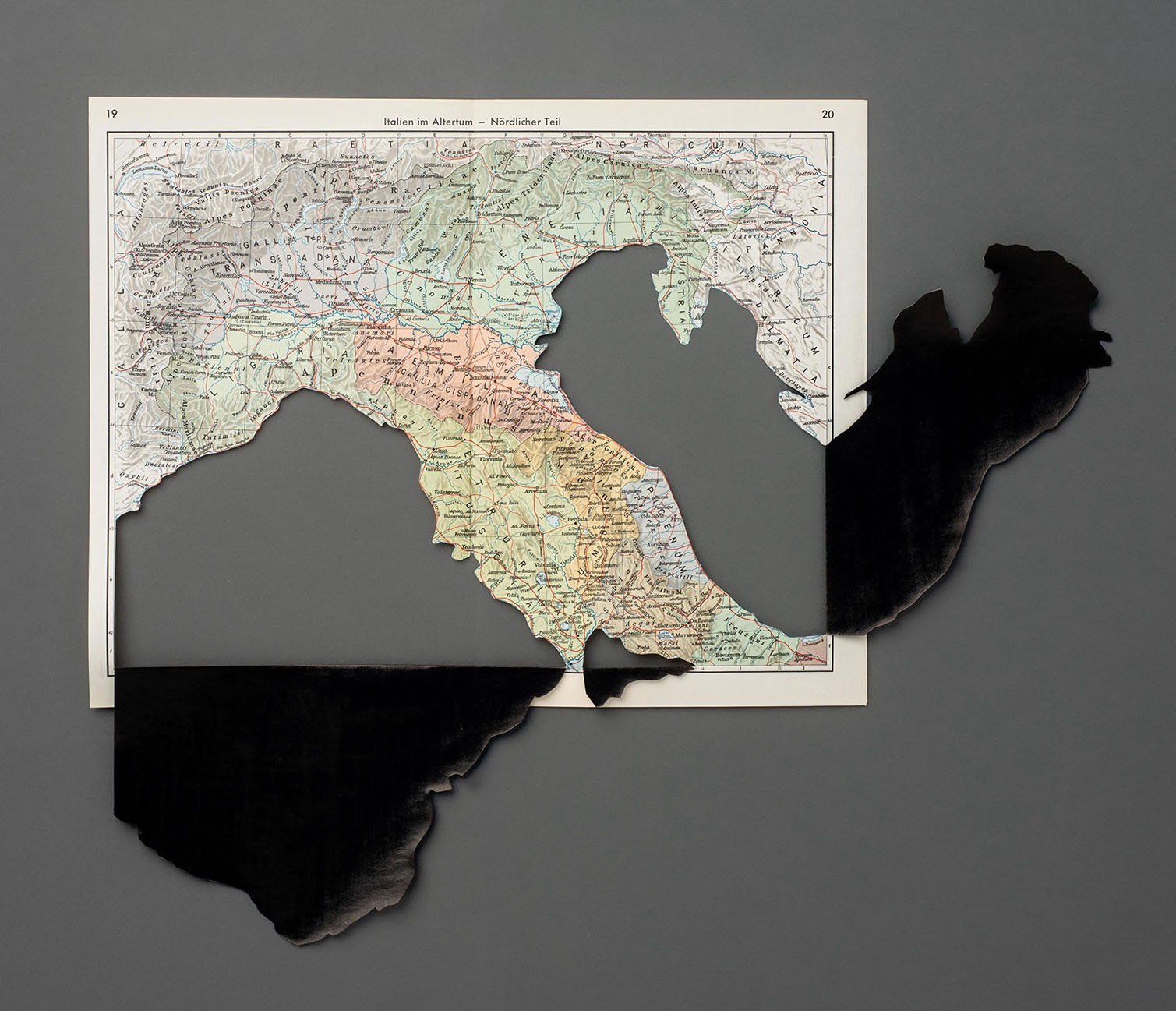
According to art historian David Summers, “[c]artography is based on two fundamental conditions: flatness, hierarchy, and metric description. Flatness is defined by the possibilities it offers for the clearest possible presentation of relationships, and maps, in one way or another, show the relationships within the world at large […]. A map shows the world conceived as a whole (or part of the world conceived as a whole) in its relationships, which may be qualitative (and hierarchical) or quantitative (and descriptive), or both. The elements of maps are generally shown in plan view, but they can also be shown in virtual space, such as views of houses or cities, for example (1).”
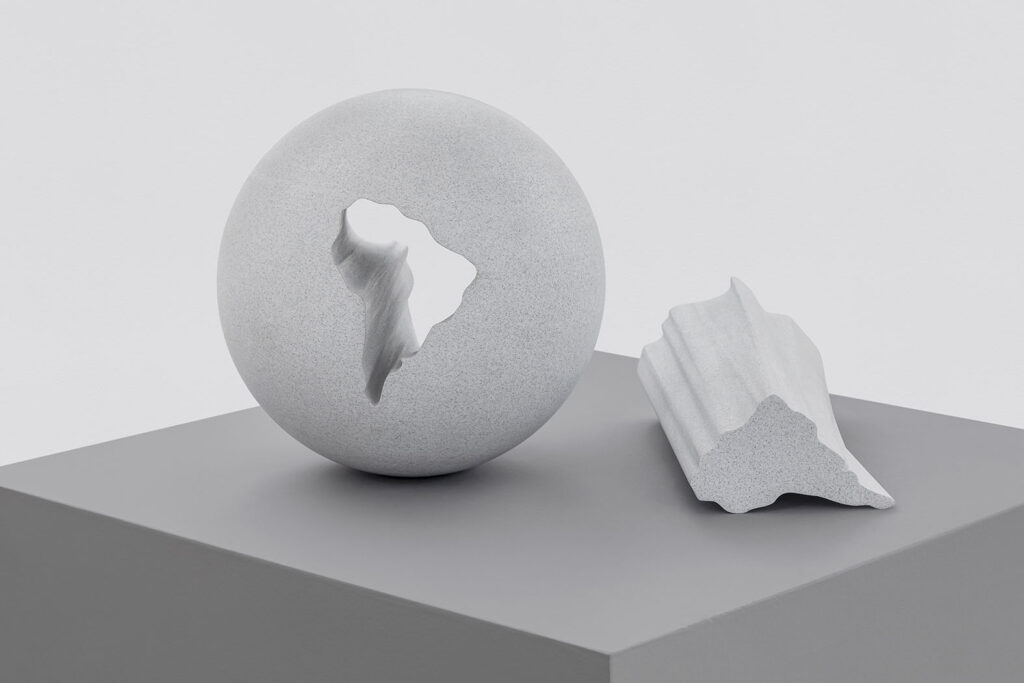
It is this aspiration to offer a totalizing image of the world—with all its ideological and illusory baggage—that seems to be mitigated, or diverted, in Marina Camargo’s works. The artist begins with a positive depiction of the planet, recognizes that something has changed there, and shows us the effect this now has on the elements of her depiction.
To represent the world map, modern cartography faced a problem similar to that of European painting in the final centuries of the Middle Ages: finding ways to reproduce three-dimensional space on a flat surface. The cartographic challenge was immense. How to define the shape and size of landmasses? Their relationship to the oceans? How to arrange elements on top of one another, or opposite one another? How to eliminate curvature and topographical features, and present everything that is sinuous and spherical as stable, outlined shapes? How to divide the political map? How to represent relief and different types of mineral formations? How to indicate paths?
It was not merely a matter of transposing the geographical relationships of a gigantic cosmic sphere onto a map, but to imbue that space with meaning and direction, to estimate the size of each landmass, to establish a basis for comparison among continents, islands, and oceans, to orient them according to the poles and cardinal points in a specific way, and to designate a center—in a legible, pragmatic manner—that would enable practical use for those who employed these projections. There were problems of definition, transposition, and orientation in every sense of the word.
Such decisions were shaped by the political, religious, and cultural particularities of the populations that demanded these projections and were transformed according to the needs of colonial domination. Uses that were supposed to be neutral but included distortions, discrepancies, and forms of subjugation and domination. Even so, the maps implied a certain stability in the relationship between what was solid, what was liquid, what was atmosphere—each division of political space.
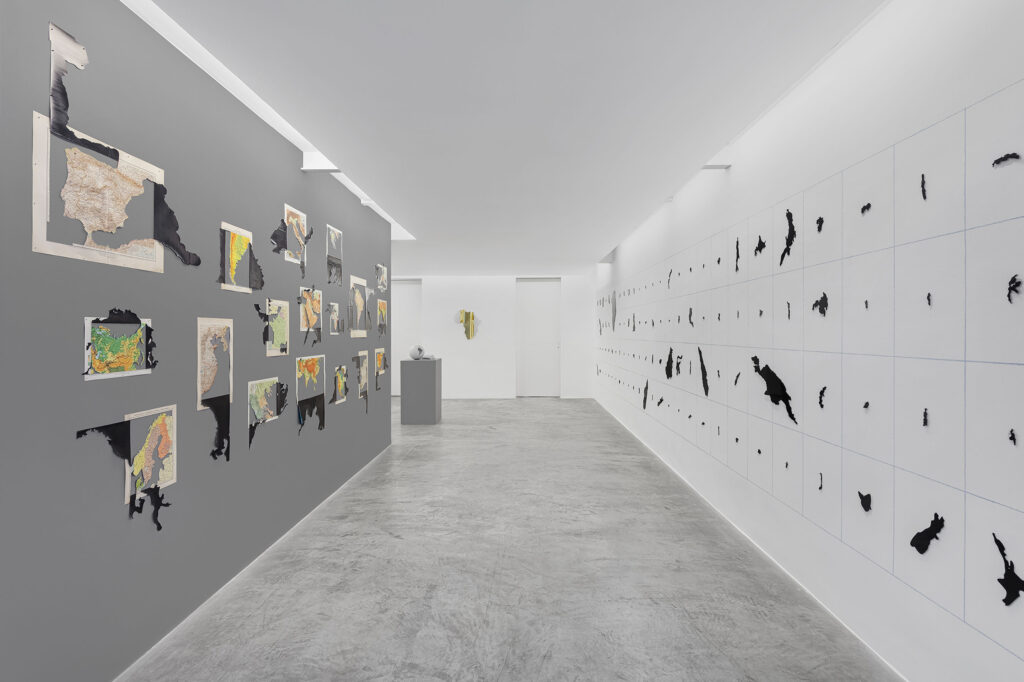
Unlike reality, these works posited a world that was already complete, as if it had emerged untouched from creation. But their use indicated constant and violent transformations, which often, as they say, redrew the maps.
This seems to be the subject of Marina Camargo’s “Sistema-mundo” works. There, everything is changed; everything is movement. The presumed connections seem to unravel, and other relationships are suggested among the terms employed. Not only do living beings circulate through this superficial landscape, but the landscape itself changes due to political, social, environmental, and cultural crises. The map here is the narrative of misalignment and absurdity—not the chart that allows us to find everything in its place, but an indication of shifting connections and permanent entropy.
It is no coincidence that the artist adopts the world-systems theory—developed by intellectuals such as Immanuel Wallerstein, Giovanni Arrighi, and Samir Amin—in the title of the exhibition. This theory offers an explanation of historical processes related to spatial expansion. It thus posits historical geographies in which the cycle of investment, innovation, and historical continuity constitutes geographies that transcend the compartmentalization of national histories. The artist, like the authors she admires, seems interested in the formation of empires and interterritorial and interstate relations in the composition of local economies, histories, and geographies. These are long-term shifts, shaping areas that form and dissolve in a world in constant transformation. These shifts—their continuities and ruptures—are of interest to Marina Camargo. This is especially true now, as we are experiencing a shift in the economic center of gravity from the Atlantic to the Pacific Ocean.
Perhaps that is why the video “The Redrawn Map” is key to understanding the entire exhibition. In it, Marina draws on newspaper quotes about international politics, set against a backdrop of intermittent destruction, war, and genocide—much like our own times. Although the phrases originally refer to specific situations, here they are deterritorialized—like her works—and transformed into clichés. They are commonplaces of what is no longer captured by the positive and stable descriptions found on maps.
At one point in the video, we read: “He said: We no longer recognize our own city.” Shortly afterward, in the same narrative, the following appears: “She said: The places have been erased from the map, and we have disappeared from the news.” The phrases that emerge point to a collapse of previous conceptions regarding the present and the future.
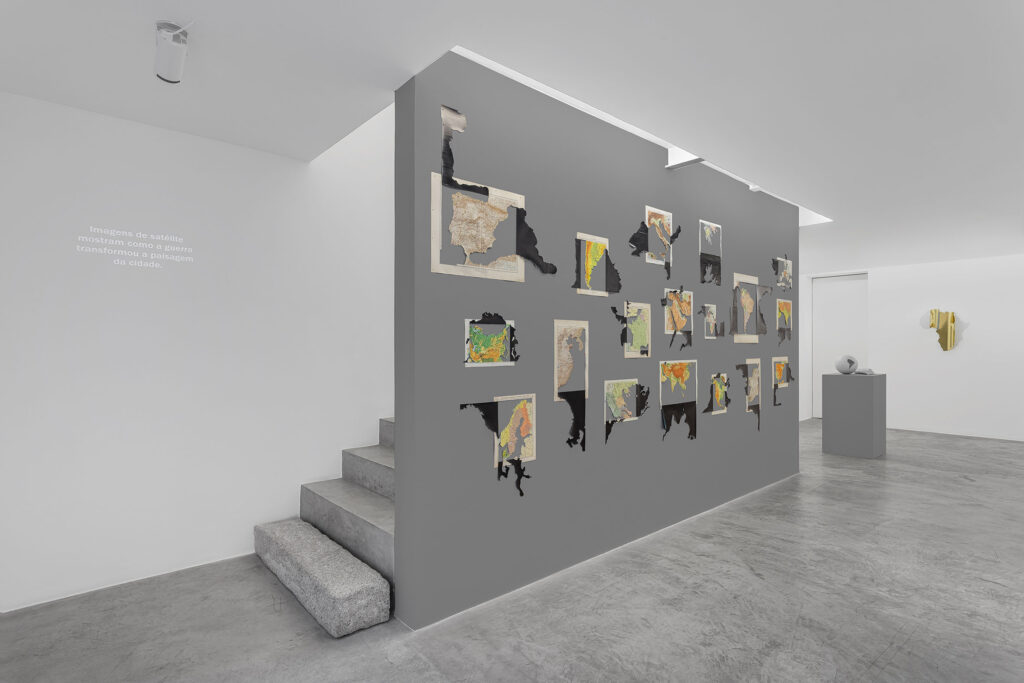
In the context in which these sentences appear, it seems that everything has been destroyed by war and that cartographic landmark—along with its paths—is no longer there. The description seems to erase the actual conditions of life, the erasure of connections, and the corrosive force that is integral to the integration of those cities into the international struggle. What, then, should be done with the maps that were used until then? How can we reconstruct new maps and new directions, taking into account the negativity of history, which is eroding any positive and stable descriptions? The entropic transformation of the maps—and of international reality—as seen from here, continues and will continue.
The artist seems to deal with what remains and no longer presents maps as guides for paths and routes; now they are geographical patches that suggest new relationships and connections between what symbolizes and what no longer symbolizes. This perspective allows us to understand works such as Mapas de fuga, Inventário de ilhas 1, and Mapa-Mole—fractions of space—from a more critical viewpoint. In Inventory of Islands 1, the maps—those patches of land in the ocean—are not related to one another: they are well-defined black spots, distributed in a regular grid like meridians, with no apparent connection to one another, much less linked to any route or continent. They are forms lost within a classification system that removes them from the rules of the geographical game and places them in a different one. Here, the islands are segregated, searching for new meanings, purposes, and relationships. This transformation, brought about by isolation, is even more pronounced in “Mapa-Mole: Fractions of Space”.
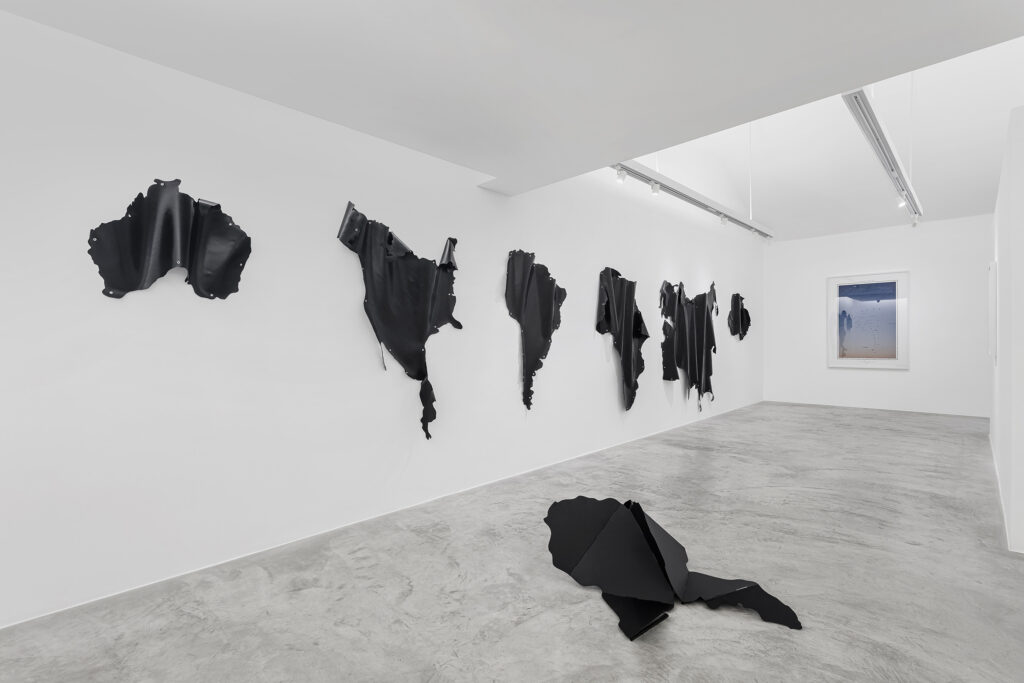
These are reconfigurations that bring Camargo’s varied procedures closer to those of artistic practices that critically engage with the arbitrariness of maps—works by artists such as Joaquín Torres García, Alighiero Boetti, Jasper Johns, Agnes Denes, Öyvind Fahlström, and so many others. Marina Camargo, like few others, understood that we live in a world undergoing very radical international transformations. In fact, even the ways in which states, institutions, and transnational corporations relate to one another seem to be changing. There is a real risk of collapse, but in more optimistic works, such as “Transitions #10” and “Continents in Transition”, the focus is on constructing new meanings in the relationships between countries and continents.
In an era of hyper-surveillance, artificial intelligence, and a technical and instrumental rationality that tends to blur with experience itself—where everything seems interpretable through the most ideological lenses possible—this casting of a shadow over earthly relationships helps to obscure a blinding and deceptive transparency, transforming it into a collection of absurdities.
(1) SUMMERS, David: Real Spaces. Londres, Phaidon Press, 2003 [p. 421]